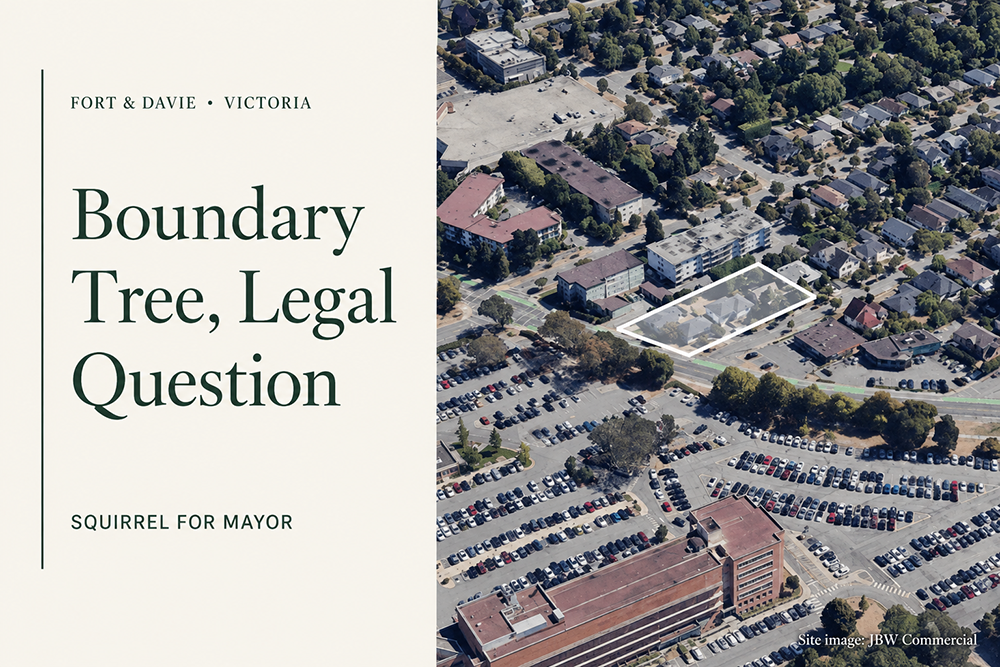
Victoria City Council had endorsed a six-storey mixed-use development at 1905–1907 Fort Street and 1923–1929 Davie Street, subject to conditions. The proposal, REZ00859 / DPV00248, includes 75 purpose-built rental units and ground-floor commercial space.
At Council’s July 23 meeting, neighbouring property owner Pam Simek of 1919 Davie Street presented a certified BC Land Surveyor (BCLS) survey concerning a mature, approximately 50-foot Rocky Mountain maple on the property boundary.
Simek told Council that the survey shows the tree trunk extending approximately eight inches across the legal property line onto her property.
Victoria’s Shared-Tree Rule
Victoria’s Tree Protection Bylaw No. 21-035 defines a “shared tree” as:
“a tree with any part of its trunk or trunk flare crossing a property line”
Section 10(1)(c) requires an application for removal of a protected shared tree to include:
“written consent from the adjacent property owner”
Simek told Council:
“As legal co-owner of this boundary tree, I withhold my consent.”
The certified survey is therefore relevant to the City’s tree-permit process. If the survey establishes that the maple tree meets Victoria’s definition of a shared tree, an application for its removal would require Simek’s written consent under Section 10(1)(c).
Tree #2975
Simek also referred to the project’s arborist report, which identified the maple as Tree #2975 and classified it as an on-site tree.
She quoted the report:
“The following bylaw protected onsite trees are located where they are likely to be severely impacted by proposed construction and are recommended for removal.”
According to Simek, the proposed parkade ramp and excavation conflict with the tree.
The new BCLS survey therefore raises a factual question about Tree #2975: is it an on-site tree, as identified in the arborist report, or a shared tree as defined by Victoria’s bylaw?
Protection Extends Beyond Removing the Trunk
Victoria’s bylaw also regulates activities that damage protected trees.
Its definition of “damage” includes harming roots within a protected root zone, changing grade, operating heavy equipment within the protected root zone, removing soil, and excavation that damages roots.
The question is therefore not limited to whether Tree #2975 can be removed. The proposed construction must also comply with the bylaw’s protections against damage to a retained protected tree.
BC Property Law
Simek cited the British Columbia Court of Appeal decision Anderson v. Skender (1993) concerning trees situated along property boundaries and the rights of neighbouring property owners.
The case operates separately from Victoria’s municipal permitting system. The City’s Tree Protection Bylaw does not determine private ownership rights.
For the Fort/Davie application, the immediate municipal provision is Section 10(1)(c): removal of a protected shared tree requires written consent from the adjacent property owner.
Simek has stated publicly that she will not provide that consent.
Council’s approval of REZ00859 / DPV00248 does not itself constitute a tree-removal permit.
The question now is how the certified BCLS survey affects subsequent tree and construction permitting for the approved design.
Boundary Trees: Four Practical Steps
1. Establish the Property Line
Where a mature tree is close to a development boundary, a BC Land Surveyor can establish the legal property line and the location of the tree trunk or trunk flare.
This matters because Victoria defines a shared tree by whether any part of its trunk or trunk flare crosses the property line.
2. Obtain an Arborist Assessment
A qualified arborist can document the tree’s size, condition, protected root zone and likely impacts from proposed excavation or construction.
3. Understand Your Property Rights
Before signing construction access, easement or underpinning agreements affecting your property, obtain independent advice.
For removal of a protected shared tree, Victoria’s bylaw requires the adjacent property owner’s written consent.
4. Submit the Evidence to the City
Submit legal surveys, arborist reports and relevant correspondence to City Planning and Parks so the information forms part of the development and tree-permit record.
References
City of Victoria — Tree Protection Bylaw No. 21-035
Definition of “shared tree”; tree-damage provisions; development-related tree permits; and Section 10(1)(c), requiring adjacent-owner written consent for removal of a protected shared tree.
Read the Tree Protection Bylaw →
City of Victoria — REZ00859
Rezoning application for 1905–1907 Fort Street and 1923–1929 Davie Street.
View the rezoning application →
City of Victoria — DPV00248
Development Permit with Variances associated with the Fort/Davie development.
City of Victoria — REZ00859 / DPV00248 Council Materials
Staff reports, plans, applicant materials and supporting documents.
View Council materials and attachments →
Anderson v. Skender (1993), British Columbia Court of Appeal
BC decision concerning trees located along property boundaries and neighbouring property rights.
Times Colonist — “Victoria council endorses six-storey mixed-use project for Upper Fort Street with conditions”
Read the Times Colonist article →
Pam Simek — Presentation to Victoria City Council, July 23, 2026
Presentation concerning the BCLS survey, Tree #2975 and her refusal to consent to removal of the shared tree.