By Squirrel For Mayor
At the March 17, 2026 Saanich Council decision approving a rezoning application and development permit for a six-storey condo proposed for the corner of 961 McKenzie and 3986, 3990 Saanich Road, the justification was familiar — and explicitly stated.
Loss of Garry oaks, we were told, is the price of protecting forests elsewhere.
As reported in the Times Colonist, Mayor Dean Murdock framed the decision this way:
“Nobody takes any pleasure in seeing the loss of Garry oaks,” Murdock said, adding that approving density in Saanich can help reduce pressure to clear forests in places like the West Shore.
Comments later erupted on a local Saanich Facebook community page:
“I’d rather lose this many trees for an apartment building… than clear actual forest for 60 single family homes in the West Shore…”
“As for the filthy garbage Garry oaks, good riddance. The island is filled with them.”
Unfortunately, these aren’t fringe opinions. They reflect a growing and normalized way of thinking — one that is now shaping both public discourse and land use decisions.
Problem with “Trade-Off” Thinking
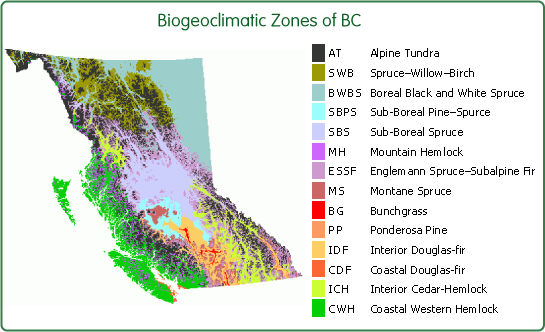
The site in question lies within the Coastal Douglas-fir Moist Maritime Biogeoclimatic subzone (CDFmm) – the smallest and most endangered ecological zone in British Columbia, and one of the most imperilled in Canada.
By contrast, much of the West Shore falls within the Coastal Western Hemlock (CWH) zone—a different ecological system altogether, with vastly greater extent and resilience.
Both systems are under pressure. But they are not interchangeable, and they are not equally at risk.
At first glance, Mayor Murdock’s logic seems reasonable: build where people already live, and protect forests elsewhere.
But this framing rests on two assumptions—that ecosystems are interchangeable, and that loss in one place can be offset by protection in another.
Neither is supported by evidence.
There is no meaningful data showing that densification in one municipality reduces ecological loss in another. Development patterns are shaped by economics, policy, and preference—not by a simple substitution effect between regions.
The planning literature reflects this uncertainty. Research comparing compact and dispersed development shows no consistent ecological advantage to either form. Outcomes vary by context, species, and habitat quality, and existing studies “do not favour one pattern or the other”(Gagné).
Framing this as a trade-off—sacrificing one ecosystem to save another—normalizes the loss of a critically fragmented and rare ecosystem in favour of one that, while stressed, is not at comparable risk of collapse, albeit no one likes the idea of urban sprawl.
More fundamentally, this reflects a hierarchy in how climate action is understood: emissions reduction is treated as primary, while place-based biodiversity is sidelined.
That is a false divide.
In this region, biodiversity is climate adaptation. Garry oak ecosystems provide essential services—cooling, water infiltration, and habitat—that underpin resilience at the neighbourhood scale.
This imbalance is not accidental. It reflects how climate policy has evolved. Organizations like the Community Energy Association have played a key role in advancing emissions-focused strategies, particularly in the built environment. While important, this emphasis reflects an earlier phase of climate action.
As climate impacts intensify, adaptation must sit alongside mitigation. Yet this shift remains uneven. Regional initiatives continue to prioritize emissions and building performance, while place-based ecological systems remain inconsistently integrated into planning.
A Rare and Endangered System
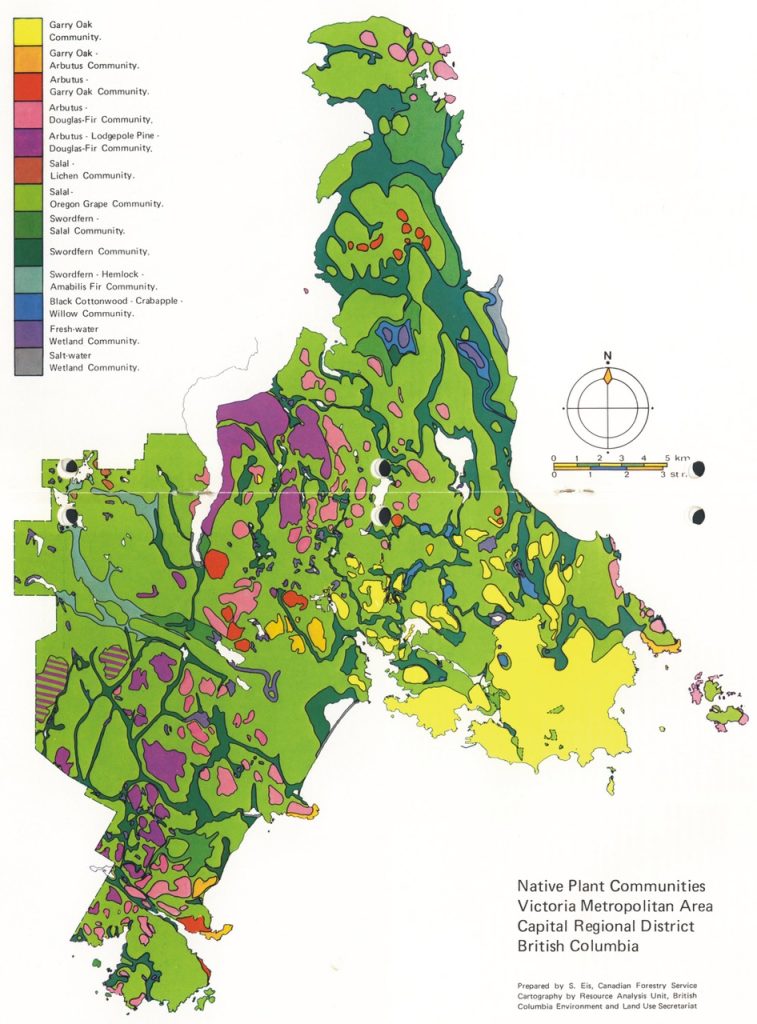
The Garry oak ecosystem is one of the most endangered ecological systems in Canada, embedded within the CDFmm zone and largely confined to the Metro Victoria region.
To dismiss these systems as expendable — or worse, abundant — reflects a deeper breakdown in ecological literacy. Garry oak ecosystems are highly fragmented remnants of what was once a much larger system, now reduced to scattered patches under intense development pressure.
A Failure of Climate Logic
We are seeing a failure of climate logic.
The Intergovernmental Panel on Climate Change is clear: climate action is not only about reducing emissions — it is also about reducing impacts. And those impacts are mediated through ecosystems: soil, water, and biodiversity.
Without functioning ecosystems, there is no climate adaptation.
Yet hierarchy persists:
- Emissions reduction and compact density = “real” climate action
- Place-based ecological work = secondary, negotiable
In regions like the CRD, biodiversity is not adjacent to climate action — it is climate adaptation.
A Category Error at the Policy Level
Mayor Murdock’s framing presents this decision as climate action. But it rests on an unexamined assumption: that ecosystems are interchangeable, and that loss in one place can be offset in another.
There is no credible evidence to support this.
Impacts can be measured at the site or municipal scale. Claims of offsetting impacts elsewhere cannot.
More importantly, the argument ignores ecological specificity.
The McKenzie/Saanich site sits within the Coastal Douglas-fir (CDFmm) zone — one of the most endangered ecological zones in Canada, including Garry oak ecosystems: shallow-soil, drought-adapted systems supporting a disproportionate number of species at risk.
By contrast, much of the West Shore lies within the Coastal Western Hemlock (CWH) zone — a fundamentally different and more continuous system.
Treating these as equivalent is a category error.
Removing a Garry oak ecosystem in Saanich does not “save” a Coastal Western Hemlock forest in Metchosin. It results in the loss of a rare, place-specific ecosystem in exchange for the hypothetical protection of a different, more common one.
What This Looks Like on the Ground
At 961 McKenzie Avenue, this abstraction becomes material.
- Total site area: 1,745 m²
- Permeable area: 374 m² (21%)
- Impermeable area: ~78.5%
This is not simply “tree loss.” It is the removal of a functioning ecosystem:
- 28 trees removed
- 18 Garry oaks (plus red cedar and Douglas fir)
- 0 trees retained on site
Replanting does not restore this:
- 31 replacement trees (bylaw requires 45)
- 4 Garry oaks (3 relegated to boulevard space)
- 14 trees shifted to cash-in-lieu
- Planting palette dominated by ornamental species
- Underground parkade = root space collapse
This is not replacement in kind.
The planting strategy prioritizes landscape aesthetics over ecosystem recovery—reflected in the choice of a Vancouver-based landscape architect and a palette with limited ecological function:
- 4 Garry oaks (keystone species; supports ~1,645 species; 200–500 year lifespan)
- 8 Pacific dogwood (low canopy, primarily aesthetic)
- 10 Southern magnolia (non-native; low biodiversity value)
- 6 vine maples (soil stabilization; moderate habitat value)
- 3 Canadian serviceberries (minimal canopy)
- 2 Armstrong Gold maples (narrow form; limited canopy)
- 1 columnar Saskatoon (negligible canopy)
Canopy loss vs replacement:
- Existing Garry oak canopy: 4,879 m²
- Replacement at planting (Garry oaks only): 38.5 m² (~0.8%)
- All replacement trees combined: 202.4 m² (~4.1%)
Soil constraints:
- Large trees require ~16 m³ soil volume each (City of Victoria sets 35 m² at minimum for large at maturity trees)
- Most plantings are confined to:
- Narrow perimeter beds
- Boulevard strips
- Raised or recessed planters
Meaningful canopy recovery on site is unlikely.
This is not mitigation.
It is erasure.
What the Rationale Actually Says
At the March 17, 2026 decision approving a 961 McKenzie Ave at Saanich road development, the applicant acknowledges the ecological value – then proceeds to remove it.
Aidan McColloch, Development Coordinator for SEBA construction, spoke at the March 16, 2026 Saanich Council on the project.
“Because of the nature of this site, and the surrounding environment, the most important considerations in the review process are the existing trees and the Garry oak ecosystem in the area. The trees on the property were carefully evaluated with a detailed arborist report and tree management plans are part of the application. Due to the physical constaints of the site, including access requirements, servicing infrastructure, and building placement, it is unfortunately not possible to accomodate development on this property without removing the existing trees.
We recognize the loss of the mature trees, particularly Garry oaks is a difficult outcome, and some people, something people care deeply about. It’s for that reason that proposal includes a substantial landscape response, including 31 replacement trees, a diverse planting strategy, including rain gardens and native species, in addition to landscape improvements on the property itself, we’ve also worked with the Swan Lake Nature Sanctuary to support restoration of Garry oak ecosystems in the surrounding area. The project includes a $30,000 contribution to the Sanctuaries adopt a hatch program which supports invasive species removal, habitat restoration on Christmas Hill, and supporting this restoration work in the area such as Christmas Hill’s strength (sic) and intact Garry oak ecosystems that are critical to the long term urban health of these species. This contribution is in addition to the $86,000 we’ve already allocated to imporvements to the Swan Lake Creek supporting environmental initiatives in the immediate neighbourhood.”
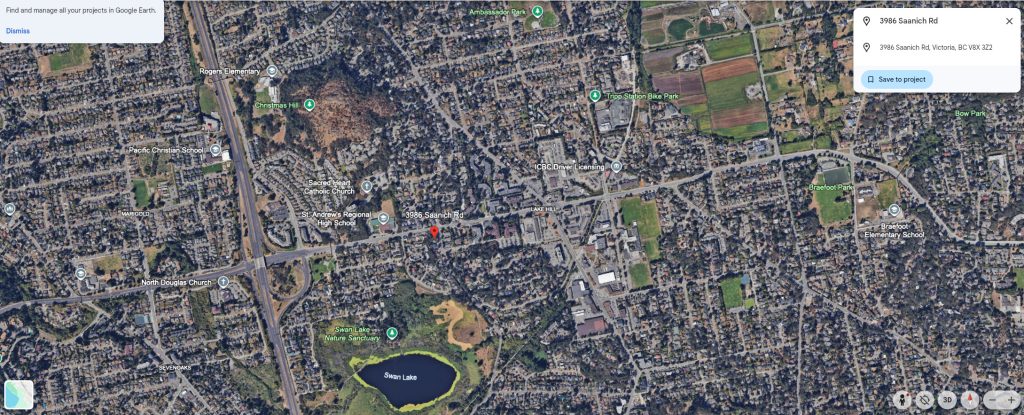
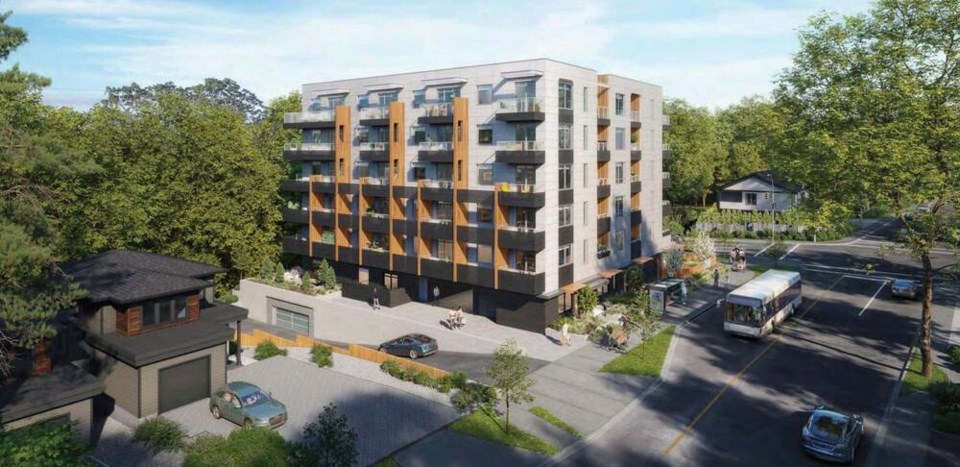
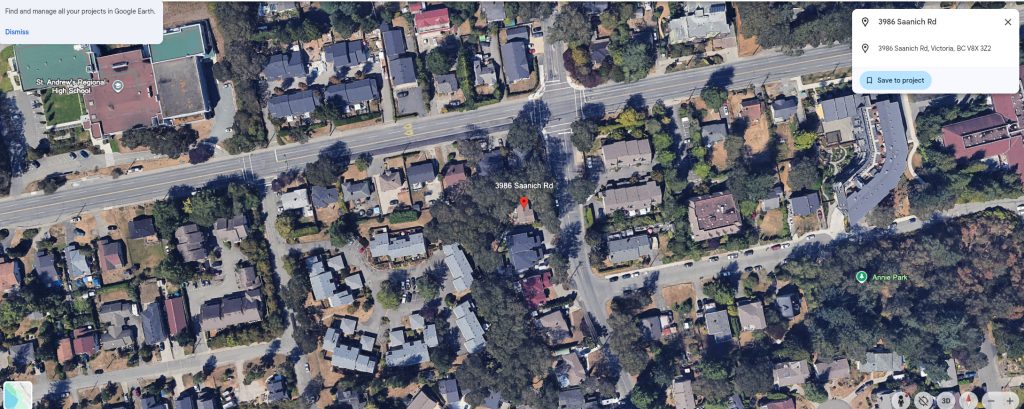
The image above shows the site wedged between Swan Lake and Christmas Hill Nature Sanctuaries.
The Quadra McKenzie Plan proposes turning these intersections into six-storey hubs on all four corners—buildings nearly twice the height of the existing Garry oak canopy.
This is not context-sensitive planning. It is canopy replacement by concrete.
Policy 6.2.2 points toward “green links” between the sanctuaries—but these are designed for people, not for wildlife. At the same time, both sanctuaries were removed from the plan’s boundary maps, effectively removing them from consideration.
What remains is a framework built on three assumptions:
- Ecology is acknowledged, but not allowed to constrain outcomes
The Garry oak ecosystem is identified as “most important,” yet it has no influence on what gets built. - Loss here can be offset elsewhere
On-site destruction is justified through off-site restoration and infrastructure upgrades—treating ecosystems as interchangeable. - Replacement equals equivalency
“31 replacement trees” and “diverse planting” are presented as mitigation. They are not. They do not replicate soil systems, species relationships, hydrology, canopy function, time, or wildlife corridors.
This is not ecological planning.
It is the administrative removal of nature—followed by its symbolic replacement.
The Deeper Structural Problem
This outcome is not accidental. It reflects how policy is structured.
Ecological systems are not treated as limits. They are treated as variables—negotiated through variances, reduced plantable space, and cash-in-lieu.
Contiguous plantable space, once presented as a condition for density, is incrementally traded away. Across the region, this becomes systemic loss.
The question is no longer whether we recognize the value of these ecosystems.
The question is whether that recognition has any force in decision-making.
Because if it does not—if ecosystems can be acknowledged, quantified, and then removed—then this is not place-based planning for climate mitigation.
Climate action is not separate from biodiversity, nor is it achieved through planting palettes that simulate function without restoring it. Climate adaptation lives in soil systems, canopy continuity, and species relationships—not in the arithmetic of replacement trees or the aesthetics of landscaping.
If biodiversity remains negotiable, and plantable space is treated as sufficient, we are not addressing climate impacts.
We are rationalizing their disappearance.
The loss of a Garry oak ecosystem cannot be offset, nor replicated through fragmented planting.
And yet, this is how multispecies extinction occurs:
not through ignorance of value, but through systems that recognize it— and proceed with their elimination anyway.
Works Cited
Comment on “Despite loss of tree, Saanich clears path for six-storey condo on McKenzie.” Facebook Save Our Saanich, 18 Mar. 2026.
Comment on “Despite loss of tree, Saanich clears path for six-storey condo on McKenzie.” Facebook Save Our Saanich, 18 Mar. 2026.
Intergovernmental Panel on Climate Change. Climate Change 2022: Impacts, Adaptation and Vulnerability. Contribution of Working Group II to the Sixth Assessment Report. 2022. https://www.ipcc.ch/report/ar6/wg2/
Stark, Stuart. Public comment on 961 McKenzie Avenue and 3986 and 3990 Saanich Road. District of Saanich Mayor and Council meeting, 16 Mar. 2026. Webcast. Personal transcript. (16:10 – 19:10)
Aidan McColloch. SEBA Presentation to District of Saanich Mayor and Council regarding 961 McKenzie Avenue and 3986 and 3990 Saanich Road, 16 Mar. 2026 (3:58 -7:19)
“Despite loss of tree, Saanich clears path for six-storey condo on McKenzie.” Times Colonist, Mar. 2026.
About BEC and BGC Units.” Centre for Forest Conservation Genetics, University of British Columbia,
https://cfcg.forestry.ubc.ca/resources/cataloguing-in-situ-genetic-resources/about-bec-and-bgc-units/. Accessed 19 Mar. 2026.
Gagné, Sarah A., et al. How and Where Sprawl and Compact Residential Development Affect Biodiversity. npj Urban Sustainability, vol. 5, 2025, article 106.
Images and Video links
- Comment on “Despite loss of tree, Saanich clears path for six-storey condo on McKenzie.” Facebook, Save Our Saanich, 18 Mar. 2026
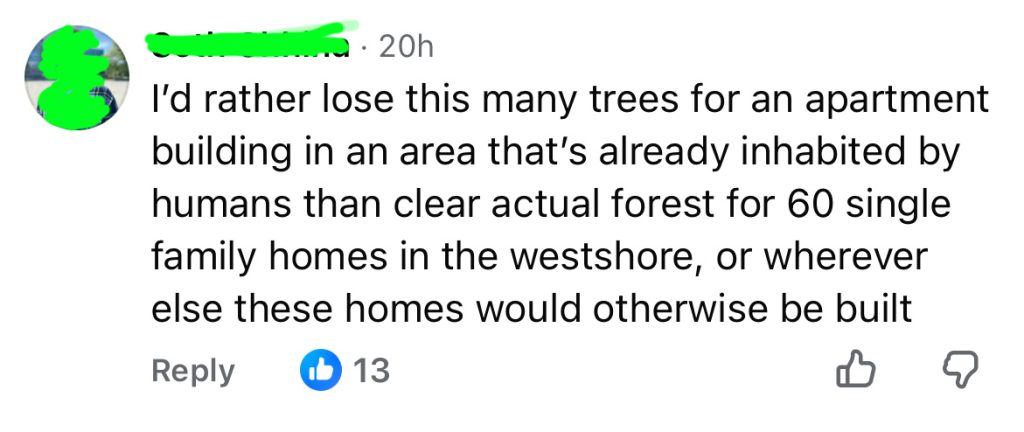
2. Comment on “Despite loss of tree, Saanich clears path for six-storey condo on McKenzie.” Facebook, Save Our Saanich, 18 Mar. 2026
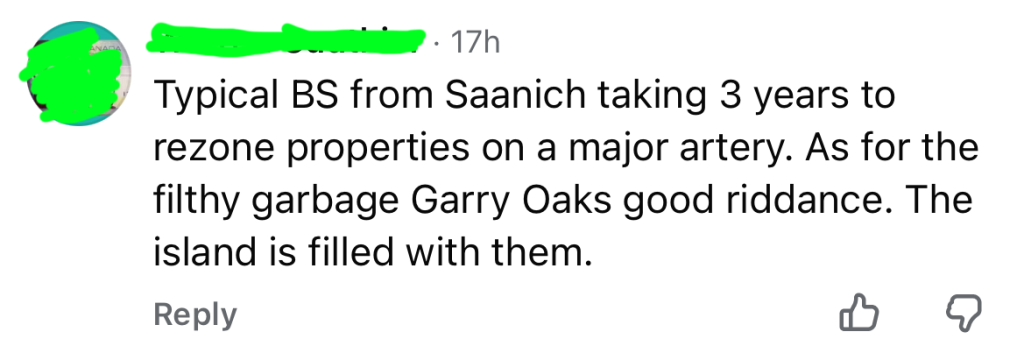
Video, Saanich Council Meeting. Monday March 16, 2026.
https://saanich.ca.granicus.com/player/clip/1260?redirect=true
961 MCKENZIE AVENUE, AND 3986 AND 3990 SAANICH ROAD – DEVELOPMENT PERMIT AND REZONING APPLICATIONReport of the Director of Planning dated February 5, 2026. To give three readings to “Zoning Bylaw, 2003, Amendment Bylaw, 2026, No. 10242” to rezone 961 McKenzie Avenue, 3986 and 3990 Saanich Road from the RS-10 and RS-6 (Single Family Dwelling) Zones to the RA-11 (Apartment) Zone to construct a six-storey apartment; and approve Development Permit DPR01057 with variances requested for projections, setbacks, visitor parking, loading spaces, parking space depth, parking aisle width, setback from a lot line abutting a street, driveway proximity to window, driveway access width, and relaxation to the Transportation Demand Management requirements. Supplemental Memo of the Director of Planning dated March 12, 2026. To provide the updated community amenity contributions.